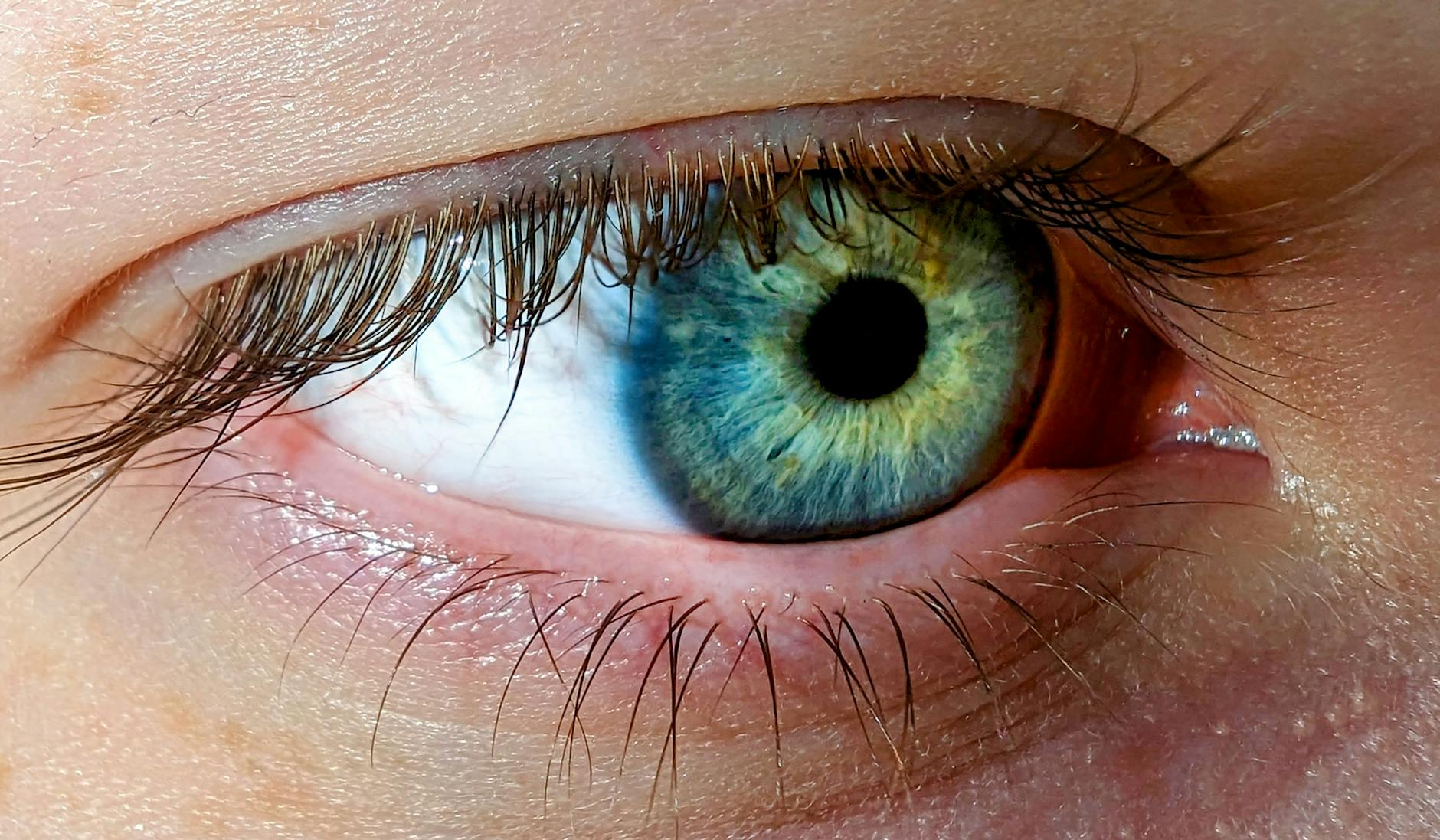
Brown eyes, blue eyes, green eyes, amber, hazel — the diversity of colors found in human eyes is one of the most visible and fascinating manifestations of genetic variation. For centuries, eye color inheritance was explained by simplistic models: one gene pair, dominant and recessive. Modern science has revealed something far richer and more complex. At least 16 different genes contribute to determining eye color, and the combinations of variants in these genes explain everything from the rarest gray-green tones to the deepest brown.
Understanding the genetics of eye color is not merely a curiosity: it illustrates how apparently simple traits conceal layers of sophisticated molecular regulation, and how modern genomics can reveal nuances that completely escaped clinical observation. This article explores the key genes in this process, the molecular mechanisms involved, and what this knowledge means for personalized medicine and population genetics.
Global fact: The distribution of eye colors worldwide is highly uneven. It is estimated that approximately 79% of the world's population has brown eyes, while only 8–10% have blue eyes — predominantly in northern and eastern European populations — and 2–3% have green eyes, the rarest shade globally. All of this diversity is orchestrated primarily by variants in a handful of genes that control the quantity and type of melanin in the iris.
The Biology of Eye Color: Melanin in the Iris
Eye color is determined by the amount and type of melanin present in the iris stroma — the anterior layer of the iridian tissue. There are two main types of melanin produced by iris melanocytes:
- Eumelanin: dark brown to black pigment, responsible for brown and dark eyes
- Pheomelanin: yellow-reddish pigment, which contributes to amber and golden tones
Blue and gray eyes do not contain blue pigment: they have little or no melanin in the anterior stroma, and the blue color results from Rayleigh scattering — the same phenomenon that makes the sky blue. Light at shorter wavelengths (blue/violet) is scattered more efficiently by collagen fibers in the melanin-poor stroma, while longer wavelengths (red/yellow) are absorbed. Green eyes combine a small amount of yellow melanin (pheomelanin) with this light scattering, creating the characteristic blend of tones.
Therefore, the question "which gene controls eye color?" is really the question "which genes control the quantity, type, and distribution of melanin in iris melanocytes?"
The Key Genes of Eye Color
OCA2 — The Master Regulator of Melanin
The OCA2 gene (Oculocutaneous Albinism Type II) is by far the single largest determinant of eye color. It encodes a transmembrane protein located in melanosomes (melanin-producing organelles inside melanocytes) that regulates intramelanosomal pH and the transport of melanin precursors. Without functional OCA2, melanin production drops dramatically — complete loss-of-function mutations cause oculocutaneous albinism type 2.
Common polymorphisms in OCA2 have more subtle, but profoundly significant effects. One particular SNP — rs1800407 (R419Q) — is among the most strongly associated with eye color variation in Europeans. But the most dramatic effect does not come from OCA2 itself, but from a regulatory region located in the neighboring gene.
HERC2 — The Master Switch of OCA2
The HERC2 gene (HECT And RLD Domain Containing E3 Ubiquitin Protein Ligase 2) contains, in its intron 86, one of the most studied genetic variants in the history of human trait genetics: the SNP rs12913832. This polymorphism is located in an enhancer (transcriptional activator) that regulates OCA2 expression in the eye's pigmented epithelium.
The ancestral allele (A) maintains high enhancer activity, resulting in high OCA2 expression and, consequently, greater melanin production and brown eyes. The derived allele (G), which arose from a single mutation in a European ancestor approximately 6,000–10,000 years ago, dramatically reduces enhancer activity, decreasing OCA2 expression and resulting in little melanin in the iris — blue eyes.
An analysis published in Human Genetics (Sturm et al., 2008) showed that the rs12913832 SNP alone explains more than 74% of the variation between blue and brown eyes in European populations — an extraordinarily large effect for a single complex-trait polymorphism. Homozygous GG individuals have approximately an 85% probability of having blue eyes; heterozygous AG individuals often have intermediate eye colors (green, hazel, gray).
TYR — The Central Enzyme of Melanin Synthesis
The TYR gene encodes tyrosinase, the rate-limiting and essential enzyme in the melanin synthesis pathway. Tyrosinase catalyzes the first two steps of eumelanin biosynthesis: the conversion of tyrosine to DOPA and of DOPA to dopaquinone. Without functional tyrosinase, no melanin is produced — complete mutations cause oculocutaneous albinism type 1.
Hypomorphic functional variants in TYR have more gradual effects on the amount of melanin produced. The polymorphism rs1042602 (S192Y) is particularly relevant for eye and skin color in European populations, influencing tyrosinase's catalytic efficiency. A GWAS analysis published in Nature Genetics (Liu et al., 2010) with more than 17,000 participants confirmed TYR as one of the highest-effect loci for eye color beyond the HERC2/OCA2 axis.
TYRP1 — The Melanin Quality Modifier
The TYRP1 gene (Tyrosinase-Related Protein 1) encodes an enzyme that acts downstream in the melanin synthesis pathway, specifically influencing the ratio between eumelanin and pheomelanin and melanosome stability. Variants in TYRP1 are strongly associated with brown versus lighter brown/amber color in various populations. The SNP rs1408799 in TYRP1 has been identified in multiple GWAS as an independent contributor to eye color variation, particularly for warmer tones (amber, golden-brown).
SLC24A4 — The Blue Eye Gene Independent of HERC2
The SLC24A4 gene (Solute Carrier Family 24 Member 4) encodes a cation transporter (NCKX4) expressed in melanocytes that regulates calcium and potassium flow in melanosomes, indirectly affecting the maturation and function of these organelles. The SNP rs12896399 in SLC24A4 is among the most replicated in eye and hair color studies in European populations.
Notably, SLC24A4 exerts an effect on eye color that is partly independent of the HERC2/OCA2 axis, contributing to the variation of blue versus green eyes and to intermediate pigmentation (hazel, gray-green). This helps explain why two individuals with the same HERC2 genotype can have perceptibly different eye colors.
| Gene | Primary Function | Impact on Eye Color |
|---|---|---|
| HERC2 | Regulates OCA2 expression via enhancer in intron 86 | SNP rs12913832 explains >74% of blue vs. brown variation in Europeans; G allele reduces iris melanin |
| OCA2 | Melanosome membrane protein; regulates pH and melanin precursor transport | Polymorphisms reduce melanin production; complete mutations cause albinism type 2 |
| TYR | Tyrosinase: rate-limiting and essential enzyme in melanin synthesis | Hypomorphic variants reduce total melanin quantity; SNP rs1042602 associated with lighter eyes and skin |
| TYRP1 | Tyrosinase-related protein; regulates eumelanin/pheomelanin ratio | SNP rs1408799 influences amber/golden vs. pure brown tones |
| SLC24A4 | Cation transporter in melanosomes; regulates melanosomal maturation | SNP rs12896399 independently contributes to blue vs. green and intermediate tones |
Why Eye Color Is More Complex Than It Appears
For decades, textbooks taught that eye color followed a simple Mendelian pattern: brown eyes are dominant over blue, and a blue-eyed couple could only have blue-eyed children. Modern genomics has completely dismantled this myth.
Because eye color is controlled by at least 16 genetic loci with additive and interactive effects, it is entirely possible that:
- Two blue-eyed parents have a brown-eyed child (if both carry higher-activity OCA2 alleles at other loci that compensate for HERC2)
- Two brown-eyed parents have green- or blue-eyed children
- Siblings with identical HERC2 genotypes present perceptibly different eye colors due to variants in SLC24A4, TYRP1, and other modifier genes
A landmark study published in PLOS Genetics (Branicki et al., 2011) developed a predictive model using 6 SNPs (in HERC2, OCA2, SLC24A4, TYR, TYRP1, and IRF4) that achieved 93.3% accuracy for predicting brown eyes, but only 72.3% for blue eyes and 73.7% for intermediate eyes — demonstrating that while HERC2 dominates for extremes, predicting intermediate shades remains complex even with the best available models.
The Evolutionary Origin of Blue Eyes
One of the most surprising discoveries in modern population genetics is that all humans with blue eyes share a single common ancestor who lived approximately 6,000 to 10,000 years ago, likely in the Black Sea region or Eastern Europe. The G allele of rs12913832 in HERC2 arose as a single mutation and spread rapidly through European populations.
Why did this allele spread so quickly? Hypotheses include sexual selection (mate preference), natural selection related to light absorption at low solar irradiation latitudes, or founder effects in small populations. An analysis published in Human Genetics (Eiberg et al., 2008) demonstrated, through sequencing of blue-eyed individuals from different European countries and Turkey, that they all share the same haplotype at the HERC2/OCA2 locus — direct evidence of a recent monophyletic origin.
Practical Implications: What Eye Color Reveals
Beyond aesthetics, the genetics of eye color has concrete medical implications:
- Uveal melanoma risk: Individuals with lighter iris coloration have less melanin protection against UV radiation inside the eye, which is associated with higher risk of uveal melanoma (a rare cancer of the uvea/choroid). Epidemiological studies show that blue and green eyes carry a 3–4 times higher risk of uveal melanoma compared to dark brown eyes.
- Light sensitivity: The lower amount of melanin in the iris of light-colored eyes results in greater intraocular light scattering, causing greater photophobia (sensitivity to bright light) — a clinical complaint that is frequently underestimated.
- Forensic medicine: Eye color prediction models from DNA (such as the IrisPlex system) are used in forensic investigations in several countries, with accuracy rates of 93–95% for brown eyes and 91–93% for blue eyes.
- Genetic ancestry: The frequency of variants in pigmentation genes is strongly structured by ancestry — making them useful markers in population genetics and genomic ancestry studies.
What helixXY Can Reveal
The genetic reports from helixXY include analysis of variants in the key pigmentation genes, including HERC2, OCA2, TYR, TYRP1, and SLC24A4. Based on your genotype, helixXY can provide:
- Analysis of your alleles at the main eye color loci, with probabilistic interpretation of melanin distribution in your iris
- Information about your relative risk of light sensitivity and the need for ocular UV protection
- The genetic ancestry context associated with the pigmentation variants identified in your genome
- An integrated visualization of how your pigmentation genes interrelate — eye, hair, and skin color frequently share genetic loci and can be interpreted together
Eye color is one of the most studied traits in human genetics precisely because it is objectively measurable, visually striking, and genetically complex. For helixXY, it represents a perfect example of how genomic analysis transforms phenotypic observations into deep molecular understanding.
Important: helixXY reports are informational and educational. Consult a healthcare professional for clinical interpretation of results, especially in contexts of ocular disease risk or UV protection use.
References
- Sturm RA, Duffy DL, Zhao ZZ, et al. A single SNP in an evolutionary conserved region within intron 86 of the HERC2 gene determines human blue-brown eye color. American Journal of Human Genetics. 2008;82(2):424–431.
- Eiberg H, Troelsen J, Nielsen M, et al. Blue eye color in humans may be caused by a perfectly associated founder mutation in a regulatory element located within the HERC2 gene inhibiting OCA2 expression. Human Genetics. 2008;123(2):177–187.
- Liu F, Wollstein A, Hysi PG, et al. Digital quantification of human eye color highlights genetic association of three new loci. PLOS Genetics. 2010;6(5):e1000934.
- Branicki W, Liu F, van Duijn K, et al. Model-based prediction of human hair color using DNA variants. Human Genetics. 2011;129(4):443–454.
- Hysi PG, Valdes AM, Liu F, et al. Genome-wide association meta-analysis of individuals of European ancestry identifies new loci explaining a substantial fraction of hair color variation and heritability. Nature Genetics. 2018;50(5):652–656.